What Is Hot Stamping Foil? Uses and Application Techniques in Textile and Leather
Look around you — chances are you've come across foil without even noticing it: on the logo of the t-shirt you're wearing, on the surface of a pair of leather shoes, or along the edge of a piece of furniture. Today, foil is far more than "a bit of gold shine" — its applications keep expanding across textiles, leather, printing, decoration, marble, and furniture. Nowhere is this growth more visible than in the textile and leather industries, which lead both in how widely foil is used and in overall consumption volume.
In this article, we explain what hot stamping foil is, how it's made, and how it's applied in the textile and leather industry.

How Is Foil Made?
Gold and silver are usually the first colors that come to mind when people think of foil — but today that's only a small part of the picture. These two classic colors have given way to a much wider foil family: multi-color, gradient, screened metallic tones, along with matte, transparent, and countless patterned varieties.
Microscopic Structure of Foil
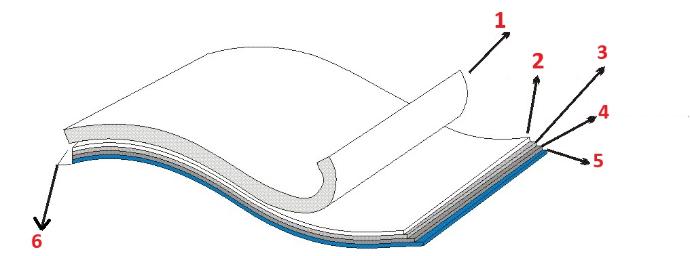
The basic production logic works like this: a metallic or matte powder coating is typically bonded onto a carrier film. But that's not the only method — foils with entirely different properties can also be produced by bonding raw materials such as polyurethane or thermo-polyurethane onto the film instead of a powder coating.

Why Are Application Conditions So Sensitive?
Just as foils vary widely in appearance, the chemicals used to produce them vary just as much. Even two foils that look nearly identical and belong to the same effect family may be manufactured with completely different chemicals to achieve their respective colors. Add to this the variety of fabric surfaces and the different effects a print is meant to achieve, and it becomes unrealistic to expect application conditions to be identical in every case.
Sometimes the desired pattern effect can only be achieved by combining more than one printing technique — which brings a risk that these applications will negatively affect one another. Excessive heat, for example, can cause fading or dulling in metallic foils. That's why it's recommended to always run a test before committing to final application conditions.
The temperature, pressure, and time values shared below reflect the most ideal conditions. If you're working with adhesives of a different chemical composition, or you notice a discrepancy between your machine's displayed values and the actual values, you can revise these conditions to match your own setup and achieve full success.
Foil Transfer Methods: Roll-to-Roll and Piece Printing

Roll-to-Roll Printing — Rotary Printing
On a rotary printing machine, a suitable adhesive paste — passed through a pre-prepared patterned mesh — is applied to the surface of the product where the foil will be transferred. This paste is then immediately fixed at the appropriate temperature.
Once the fixed surface is ready, the foil is bonded to it on a calender printing machine. Application parameters:
Fixing temperature: 145–150°C
Press temperature: 160°C
Press pressure: 6 bar
Speed: 3–5 meters/minute
After transfer, the product is shock-cooled on 4°C rollers at the machine exit, and the carrier film is then peeled off. This cooling step is a detail that shouldn't be skipped if you want a high-quality result.

Roll-to-Roll Printing — Smog Printing
Smog printing is a distinctive technique: here, the adhesive is applied directly onto the foil rather than onto the fabric — and it's for this reason that a solvent-based adhesive is used.
Using a gravure roller, the adhesive is transferred onto the foil in line with the prepared pattern. This adhesive-coated surface, which is continuously fixed in-line, is then bonded to the fabric and printed on the same production line. Parameters:
Machine speed: 30 meters/minute for standard patterns, 10–15 meters/minute for surface coatings
Temperature: 130°C
Pressure: 7–8 bar
After transfer, the foiled fabric is wound onto beams and held at 80°C for 24 hours. However, the carrier film is not peeled off at this stage — that step is carried out separately, on a different machine.

Piece Printing
Piece printing is a method applied to garment pieces that have already been cut, before sewing. It's typically done on an octopus-type press machine, where a suitable adhesive paste — passed through pre-prepared patterned flat dies — is applied to the surface of the product.
Pre-drying: The transfer paste is pre-dried at 140°C
Pressing: 160°C at 6 bar pressure
Hand presses: 6–10 seconds
Conveyor presses: 20–30 seconds
The carrier film can be peeled off right after pressing. Waiting isn't a required step — it only adds a bit more gloss; otherwise, most facilities peel it off right away in production to avoid unnecessary lost time.
Summary: Parameters by Method
Rotary Printing
160°C
6 bar
3–5 m/s
Smog Printing
130°C
7–8 bar
10–15 m/s
Piece Printing
160°C
6 bar
Press 6–10s conveyor 20–30s
If you're not sure which method and foil best fit your product and the effect you're after, the UES Varak team is happy to help you determine the right foil and application conditions — reach out via our Contact page. You can reach out via Contact Page .